Cyber Affairs
No Result
View All Result
  • Login
  • Register
[gtranslate]
  • Home
  • Live Threat Map
  • Books
  • Careers
  • Latest
  • Podcast
  • Popular
  • Press Release
  • Reports
  • Tech Indexes
  • White Papers
  • Contact
Social icon element need JNews Essential plugin to be activated.
  • AI
  • Cyber Crime
  • Intelligence
  • Laws & Regulations
  • Cyber Warfare
  • Hacktivism
  • More
    • Digital Influence Mercenaries
    • Digital Diplomacy
    • Electronic Warfare
    • Emerging Technologies
    • ICS-SCADA
    • Books
    • Careers
    • Cyber Crime
    • Cyber Intelligence
    • Cyber Laws & Regulations
    • Cyber Warfare
    • Digital Diplomacy
    • Digital Influence Mercenaries
    • Electronic Warfare
    • Emerging Technologies
    • Hacktivism
    • ICS-SCADA
    • News
    • Podcast
    • Reports
    • Tech Indexes
    • White Papers
COMMUNITY
NEWSLETTER
  • AI
  • Cyber Crime
  • Intelligence
  • Laws & Regulations
  • Cyber Warfare
  • Hacktivism
  • More
    • Digital Influence Mercenaries
    • Digital Diplomacy
    • Electronic Warfare
    • Emerging Technologies
    • ICS-SCADA
    • Books
    • Careers
    • Cyber Crime
    • Cyber Intelligence
    • Cyber Laws & Regulations
    • Cyber Warfare
    • Digital Diplomacy
    • Digital Influence Mercenaries
    • Electronic Warfare
    • Emerging Technologies
    • Hacktivism
    • ICS-SCADA
    • News
    • Podcast
    • Reports
    • Tech Indexes
    • White Papers
NEWSLETTER
No Result
View All Result
Cyber Affairs
No Result
View All Result
  • Cyber Crime
  • Cyber Intelligence
  • Cyber Laws & Regulations
  • Cyber Warfare
  • Digital Diplomacy
  • Digital Influence Mercenaries
  • Electronic Warfare
  • Emerging Technologies
  • Hacktivism
  • ICS-SCADA
  • Reports
  • White Papers

SMTP Smuggling: New Flaw Lets Attackers Bypass Security and Spoof Emails

admin by admin
Jan 3, 2024
in News
A A
0

Jan 03, 2024NewsroomCyber Threat / Email Security

A new exploitation technique called Simple Mail Transfer Protocol (SMTP) smuggling can be weaponized by threat actors to send spoofed emails with fake sender addresses while bypassing security measures.

“Threat actors could abuse vulnerable SMTP servers worldwide to send malicious emails from arbitrary email addresses, allowing targeted phishing attacks,” Timo Longin, a senior security consultant at SEC Consult, said in an analysis published last month.

SMTP is a TCP/IP protocol used to send and receive email messages over a network. To relay a message from an email client (aka mail user agent), an SMTP connection is established between the client and server in order to transmit the actual content of the email.

Cybersecurity

The server then relies on what’s called a mail transfer agent (MTA) to check the domain of the recipient’s email address, and if it’s different from that of the sender, it queries the domain name system (DNS) to look up the MX (mail exchanger) record for the recipient’s domain and complete the mail exchange.

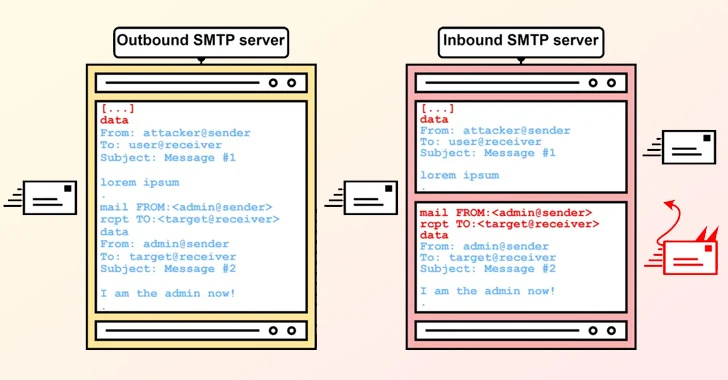
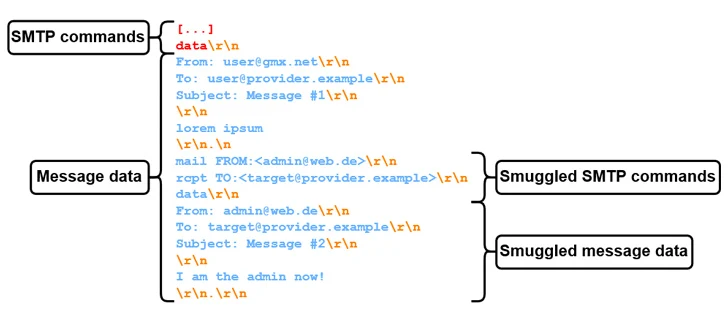
The crux of SMTP smuggling is rooted in the inconsistencies that arise when outbound and inbound SMTP servers handle end-of-data sequences differently, potentially enabling threat actors to break out of the message data, “smuggle” arbitrary SMTP commands, and even send separate emails.
SMTP Smuggling

It borrows the concept from a known attack method known as HTTP request smuggling, which takes advantage of discrepancies in the interpretation and processing of the “Content-Length” and “Transfer-Encoding” HTTP headers to prepend an ambiguous request to the inbound request chain.

Specifically, it exploits security flaws in messaging servers from Microsoft, GMX, and Cisco to send emails spoofing millions of domains. Also impacted are SMTP implementations from Postfix and Sendmail.

Cybersecurity

This allows for sending forged emails that seemingly look like they are originating from legitimate senders and defeat checks in place erected to ensure the authenticity of incoming messages – i.e., DomainKeys Identified Mail (DKIM), Domain-based Message Authentication, Reporting and Conformance (DMARC), and Sender Policy Framework (SPF).

While Microsoft and GMX have rectified the issues, Cisco said the findings do not constitute a “vulnerability, but a feature and that they will not change the default configuration.” As a result, inbound SMTP smuggling to Cisco Secure Email instances is still possible with default configurations.

As a fix, SEC Consult recommends Cisco users change their settings from “Clean” to “Allow” in order to avoid receiving spoofed emails with valid DMARC checks.


Read the full article here

Leave a Reply Cancel reply

Your email address will not be published. Required fields are marked *

[mc4wp_form id=”387″]

Recent News

  • Understanding the Implications & Guarding Privacy- Axios Security Group
  • Hackers Actively Using Pupy RAT to Attack Linux Systems
  • Buckle Up_ BEC and VEC Attacks Target Automotive Industry

Topics

  • AI
  • Books
  • Careers
  • Cyber Crime
  • Cyber Intelligence
  • Cyber Laws & Regulations
  • Cyber Warfare
  • Digital Diplomacy
  • Digital Influence Mercenaries
  • Electronic Warfare
  • Emerging Technologies
  • Hacktivism
  • ICS-SCADA
  • News
  • Podcast
  • Reports
  • Tech Indexes
  • Uncategorized
  • White Papers

Get Informed

[mc4wp_form id=”387″]

Social icon element need JNews Essential plugin to be activated.

Copyright © 2022 Cyber Affairs. All rights reserved.

No Result
View All Result
  • Home
  • Cyber Crime
  • Cyber Intelligence
  • Cyber Laws & Regulations
  • Cyber Warfare
  • Digital Diplomacy
  • Digital Influence Mercenaries
  • Electronic Warfare
  • Emerging Technologies
  • Hacktivism
  • ICS-SCADA
  • Reports
  • White Papers

Copyright © 2022 Cyber Affairs. All rights reserved.

Welcome Back!

Login to your account below

Forgotten Password? Sign Up

Create New Account!

Fill the forms below to register

All fields are required. Log In

Retrieve your password

Please enter your username or email address to reset your password.

Log In
This website uses cookies. By continuing to use this website you are giving consent to cookies being used. Visit our Privacy and Cookie Policy.