
Cyber Affairs
No Result
View All Result
  • Login
  • Register
[gtranslate]
  • Home
  • Live Threat Map
  • Books
  • Careers
  • Latest
  • Podcast
  • Popular
  • Press Release
  • Reports
  • Tech Indexes
  • White Papers
  • Contact
Social icon element need JNews Essential plugin to be activated.
  • AI
  • Cyber Crime
  • Intelligence
  • Laws & Regulations
  • Cyber Warfare
  • Hacktivism
  • More
    • Digital Influence Mercenaries
    • Digital Diplomacy
    • Electronic Warfare
    • Emerging Technologies
    • ICS-SCADA
    • Books
    • Careers
    • Cyber Crime
    • Cyber Intelligence
    • Cyber Laws & Regulations
    • Cyber Warfare
    • Digital Diplomacy
    • Digital Influence Mercenaries
    • Electronic Warfare
    • Emerging Technologies
    • Hacktivism
    • ICS-SCADA
    • News
    • Podcast
    • Reports
    • Tech Indexes
    • White Papers
COMMUNITY
NEWSLETTER
  • AI
  • Cyber Crime
  • Intelligence
  • Laws & Regulations
  • Cyber Warfare
  • Hacktivism
  • More
    • Digital Influence Mercenaries
    • Digital Diplomacy
    • Electronic Warfare
    • Emerging Technologies
    • ICS-SCADA
    • Books
    • Careers
    • Cyber Crime
    • Cyber Intelligence
    • Cyber Laws & Regulations
    • Cyber Warfare
    • Digital Diplomacy
    • Digital Influence Mercenaries
    • Electronic Warfare
    • Emerging Technologies
    • Hacktivism
    • ICS-SCADA
    • News
    • Podcast
    • Reports
    • Tech Indexes
    • White Papers
NEWSLETTER
No Result
View All Result
Cyber Affairs
No Result
View All Result
  • Cyber Crime
  • Cyber Intelligence
  • Cyber Laws & Regulations
  • Cyber Warfare
  • Digital Diplomacy
  • Digital Influence Mercenaries
  • Electronic Warfare
  • Emerging Technologies
  • Hacktivism
  • ICS-SCADA
  • Reports
  • White Papers

Quasar RAT Leverages DLL Side-Loading to Fly Under the Radar

admin by admin
Oct 23, 2023
in News
A A
0

Oct 23, 2023NewsroomCyberattack / Malware

The open-source remote access trojan known as Quasar RAT has been observed leveraging DLL side-loading to fly under the radar and stealthily siphon data from compromised Windows hosts.

“This technique capitalizes on the inherent trust these files command within the Windows environment,” Uptycs researchers Tejaswini Sandapolla and Karthickkumar Kathiresan said in a report published last week, detailing the malware’s reliance on ctfmon.exe and calc.exe as part of the attack chain.

Also known by the names CinaRAT or Yggdrasil, Quasar RAT is a C#-based remote administration tool capable of gathering system information, a list of running applications, files, keystrokes, screenshots, and executing arbitrary shell commands.

Cybersecurity

DLL side-loading is a popular technique adopted by many threat actors to execute their own payloads by planting a spoofed DLL file with a name that a benign executable is known to be looking for.

“Adversaries likely use side-loading as a means of masking actions they perform under a legitimate, trusted, and potentially elevated system or software process,” MITRE notes in its explanation of the attack method.
Quasar RAT

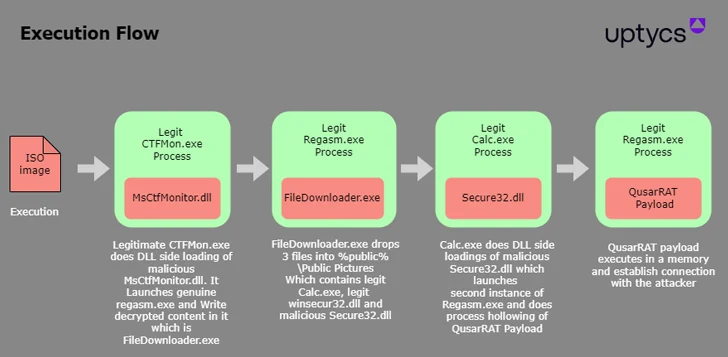
The starting point of the attack documented by Uptycs is an ISO image file that contains three files: A legitimate binary named ctfmon.exe that’s renamed as eBill-997358806.exe, a MsCtfMonitor.dll file that’s renamed as monitor.ini, and a malicious MsCtfMonitor.dll.

“When the binary file ‘eBill-997358806.exe’ is run, it initiates the loading of a file titled ‘MsCtfMonitor.dll’ (name masqueraded) via DLL side-loading technique, within which malicious code is concealed,” the researchers said.

Cybersecurity

The hidden code is another executable “FileDownloader.exe” that’s injected into Regasm.exe, the Windows Assembly Registration Tool, in order to launch the next stage, an authentic calc.exe file that loads the rogue Secure32.dll again through DLL side-loading and launch the final Quasar RAT payload.

The trojan, for its part, establishes connections with a remote server to send system information and even sets up a reverse proxy for remote access to the endpoint.

The identity of the threat actor and the exact initial access vector used to pull off the attack is unclear, but it’s likely to be disseminated by means of phishing emails, making it imperative that users be on the guard for dubious emails, links, or attachments.


Read the full article here

Leave a Reply Cancel reply

Your email address will not be published. Required fields are marked *

[mc4wp_form id=”387″]

Recent News

  • Understanding the Implications & Guarding Privacy- Axios Security Group
  • Hackers Actively Using Pupy RAT to Attack Linux Systems
  • Buckle Up_ BEC and VEC Attacks Target Automotive Industry

Topics

  • AI
  • Books
  • Careers
  • Cyber Crime
  • Cyber Intelligence
  • Cyber Laws & Regulations
  • Cyber Warfare
  • Digital Diplomacy
  • Digital Influence Mercenaries
  • Electronic Warfare
  • Emerging Technologies
  • Hacktivism
  • ICS-SCADA
  • News
  • Podcast
  • Reports
  • Tech Indexes
  • Uncategorized
  • White Papers

Get Informed

[mc4wp_form id=”387″]

Social icon element need JNews Essential plugin to be activated.

Copyright © 2022 Cyber Affairs. All rights reserved.

No Result
View All Result
  • Home
  • Cyber Crime
  • Cyber Intelligence
  • Cyber Laws & Regulations
  • Cyber Warfare
  • Digital Diplomacy
  • Digital Influence Mercenaries
  • Electronic Warfare
  • Emerging Technologies
  • Hacktivism
  • ICS-SCADA
  • Reports
  • White Papers

Copyright © 2022 Cyber Affairs. All rights reserved.

Welcome Back!

Login to your account below

Forgotten Password? Sign Up

Create New Account!

Fill the forms below to register

All fields are required. Log In

Retrieve your password

Please enter your username or email address to reset your password.

Log In
This website uses cookies. By continuing to use this website you are giving consent to cookies being used. Visit our Privacy and Cookie Policy.